
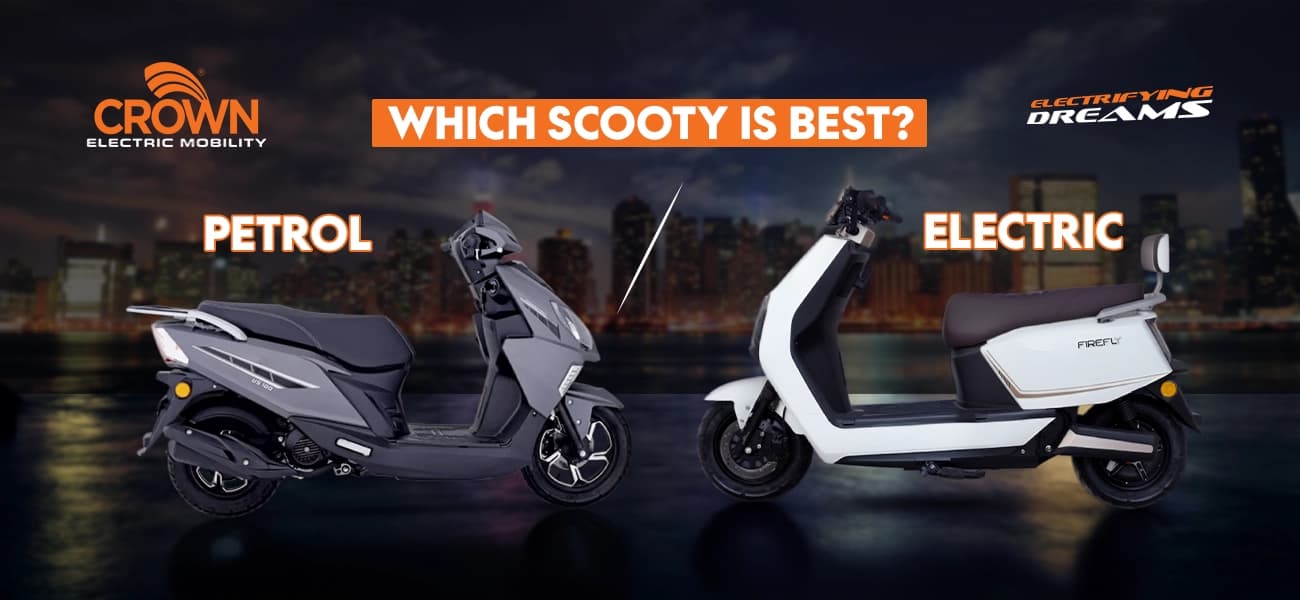

Let’s face it: If you’re reading this, you’re likely sick and tired of these fuel prices bouncing up and down, high one day, low the next. You are all set to level up your daily commute, but you’re at a crossroads, and wondering the answer to the ultimate question: which scooty is best, electric or petrol?
This is an ongoing debate in homes, tea stalls and social media forums. On one hand, you have your handy dandy and reliable old petrol scooter, noisy and familiar but always ready to go. Then, on the other side, a sleek and silent electric scooter rolls down the street, promising to save you thousands in running costs.
But which one is actually worth buying? The answer is your very own electric vehicle.
To help you decide, we have put together a comprehensive, fact-checked guide. We aren't just looking at the basics; we are diving deep into the hidden costs, battery lifespans and daily conveniences that most guides completely miss. Let’s break it down so you can make the smartest choice for your garage.
1. The Financial Battle: Upfront Cost vs. Running Cost
The biggest factor for most buyers is money. Here is how the math actually works out.
The Petrol Scooty: Traditionally, petrol scooters have a lower upfront purchase price. If you are on a tight initial budget, a standard petrol two-wheeler might seem more appealing. However, this is where the savings end. You will be paying high rates for petrol every single week. On average, a petrol engine converts only about 15% to 25% of its fuel energy into actual movement. The rest is lost as heat and noise.
The Electric Scooty: An EV scooter usually comes with a higher price tag in the showroom. But here is the kicker, running an electric scooty costs pennies compared to petrol. Electric motors are incredibly efficient (around 75% to 85% efficiency).
- The Reality Check: If a petrol bike costs around ₨1,395 to travel 100 km, an electric scooty would cost only about ₨223 in electricity for the same distance. Over 2 to 3 years, the electric scooter can practically recover the price difference just through fuel savings.
2. Maintenance: Moving Parts vs. Microchips
If you hate visiting the mechanic, you need to read this section carefully.
Petrol Engines: An internal combustion engine is a mechanical nightmare of hundreds of moving parts. To keep it running, you need regular oil changes, air filter replacements, spark plug checks and chain or belt adjustments.
Electric Motors: An electric scooter essentially has three main components: the battery, the motor and the controller. There is no engine oil, no spark plugs and no exhaust system to rust.
Battery Degradation: Competitors often tell you EVs are maintenance-free, but they leave out the reality of battery replacement. After 3 to 5 years (depending on whether you have a Lead-Acid or a modern Lithium-Ion battery), your battery will lose its capacity and need replacing. While this is a hefty one-time cost, if you calculate the money saved on three years of oil changes, tunings and fuel, the EV still comes out significantly cheaper in its Total Cost of Ownership (TCO).
3. Range and Refuelling: Gas Stations vs. The "Home Station"
The Petrol Advantage: You can ride a petrol scooter across the country. If you run low, pull into a gas station, take two minutes to fill up and you're back on the road. For intercity travellers, petrol remains the undisputed king.
The Electric Advantage (The Hidden Convenience): Critics argue that EV charging takes too long (often 4 to 6 hours). But they miss a massive lifestyle benefit: you wake up with a "full tank" every single day. With an electric scooty, you simply plug it in at home like you do your smartphone. For the average daily commuter travelling 20 to 50 km a day, you will never actually need to wait for a charge and you will never have to stand in a long queue at a petrol pump again.
4. Performance, Speed and Terrain
When you twist the throttle, how does the scooty react?
- Speed: If you are a speed enthusiast who wants to cruise at 90+ km/h on highways, a petrol scooter is currently your best bet. Most affordable EV scooters are artificially capped at around 45 to 60 km/h to preserve battery life.
- Torque and Hills: Here is where the electric scooty shines. Electric motors deliver 100% of their torque instantly. This means when the light turns green, an EV scooter will often zip away faster than a petrol one. Furthermore, this instant torque makes EVs surprisingly capable of climbing steep city inclines without "huffing and puffing" like a low-cc petrol engine.
The Reality Check: Did you know? Extreme weather affects both! Freezing temperatures can temporarily reduce an EV's battery range by up to 20%, while extreme heat can cause petrol engines to overheat.
5. The Silent Ride and Environmental Impact
It is impossible to ignore the environmental factor. Petrol scooters emit carbon monoxide, nitrogen oxides and noise pollution. If you live in a dense, noisy city, adding to the smog isn't ideal.
An electric scooter provides a noiseless and pollution-free ride. It lowers your personal carbon footprint and makes your daily commute peaceful. And now, governments are providing tax refunds, subsidised registration fees and other perks to EV drivers.
6. Resale Value: What Happens When You Sell?
Nowadays, petrol scooters just hold their resale value better because the secondary market for them has existed for decades. And buyers know exactly what they are getting.
However, the tables have turned. As the cost of fuel soars and EV infrastructure expands around the world, more and more people are on the lookout for used electric scooters. A high-quality electric scooter with Lithium ion battery will retain a much better resale value in the upcoming years.
Which One Should You Buy?
Answering the question of which scooty is best, electric or petrol,ultimately comes down to your daily lifestyle.
You should buy an Electric Scooty if:
- Your daily commute is under 60 km.
- You want to save massive amounts of money on fuel and mechanic visits.
- You have a convenient place to plug in at home or work.
- You prefer a smooth, silent and eco-friendly ride.
You should buy a Petrol Scooty if:
- You regularly travel long distances (70+ km a day) or travel between cities.
- You do not have reliable access to electricity for overnight charging.
- You prioritize high top speeds and immediate refuelling..
Ready to Make the Switch?
If you fall into the category of the daily urban commuter, the future is undeniably electric. The savings, convenience and smooth ride are unmatched.
At Crown Electric Mobility, we believe in providing top-tier, reliable and highly efficient electric two-wheelers designed for real-world roads. Don't let high fuel prices dictate your life. Explore our range of modern electric scooters today and take the first step toward a smarter, greener commute!
FAQs
1. Which scooter is best in Pakistan, electric or petrol?
Electric vehicles are, without any doubt, the simple winner. An electric motor system is 75% more efficient than an ICE (Internal Combustion Engine), which is only 15-25% efficient.
2. Should I buy an electric bike or a petrol bike?
Electric bikes (EVs) are best for city commuters seeking low running costs, minimal maintenance and eco-friendly, quiet and smooth rides.
3. Can an electric scooter last 10 years?
Yes, an electric scooter can technically last 10 years, but this requires exceptional care. However, it is most likely that they last up to 5 years or 1000 recharge cycles if taken care of.